
Weed can stay in your system for anywhere from a day to more than a month, depending on how often you use it and which test is used: urine tests usually detect it for about 3 days after a single use and 30 days or longer with heavy daily use, saliva for 1 to 3 days, blood for hours to a few days, and hair for up to about 90 days. What tests look for is not the high itself but THC and its leftover breakdown product, THC-COOH, which the body stores in fat and releases slowly. That is why detection lasts far longer than any effects you feel.
These are typical ranges from clinical and lab references, not guarantees. Individual results vary, and test sensitivity matters. This page is general information, not medical or legal advice.
How long is weed detectable by each type of drug test?
| Test | What it looks for | Occasional use | Frequent or daily use |
|---|---|---|---|
| Urine Most common for jobs | THC-COOH metabolite | About 1 to 3 days | 10 to 30+ days |
| Saliva Roadside and some workplaces | THC itself | About 1 to 3 days | Several days, occasionally longer |
| Blood Mostly after accidents | THC and metabolites | Hours, up to about 1 to 2 days | Several days to a week or more at low levels |
| Hair Rare, long lookback | THC-COOH in the hair shaft | Often not detected | Up to about 90 days |
How long does weed stay in your urine?
Urine tests are the most common, and they have the widest range. They do not detect THC itself. They detect THC-COOH, an inactive metabolite your liver makes from THC. Because THC is fat-soluble, some of it is stored in fat tissue and released slowly over days or weeks, so regular users keep producing THC-COOH long after they stop.
| Use pattern | Typical detection window |
|---|---|
| Single use | About 3 days |
| Moderate About 4 times a week | 5 to 7 days |
| Daily | 10 to 15 days |
| Heavy daily Several times a day | 30 days or more |
Most workplace screens use an immunoassay with a cutoff of 50 ng/mL of THC metabolites, and positive screens are confirmed in a lab at 15 ng/mL (Moeller et al., Mayo Clinic Proceedings, 2017). A test with a lower cutoff, such as 20 ng/mL, can pick up use for longer. The ranges above are widely cited clinical estimates, and researchers note that very heavy users have occasionally tested positive well beyond 30 days.
How long does weed stay in your system after one time?
For someone who rarely uses cannabis, a single session is usually detectable in urine for about 1 to 3 days, and in saliva for about a day or two. A larger dose, such as a strong edible or a high-potency concentrate, can stretch that toward the upper end. One hit from a joint shared with friends sits at the low end of the range, but there is no amount small enough to be guaranteed undetectable.
How long does THC stay in your saliva?
Saliva (oral fluid) tests look for THC itself, which lingers in the mouth after smoking or vaping. That makes them better at spotting recent use. A review by researchers at the National Institute on Drug Abuse found THC in oral fluid can be very high right after smoking and drops quickly over the following hours (Lee and Huestis, Drug Testing and Analysis, 2014). For occasional users the window is typically 1 to 3 days. Frequent users can test positive for longer.
How long does weed stay in your blood?
THC enters the bloodstream within minutes of smoking or vaping and peaks quickly, then falls sharply within a few hours as it moves into fat and organs. Blood tests are mainly used after crashes or in medical settings to estimate recent use. In occasional users, THC is usually gone from blood within a day or two. In heavy daily users, low levels can remain for a week or more after they stop, which is one reason a blood level is not a reliable measure of impairment.
How long does weed stay in your hair?
Hair tests have the longest lookback. A standard sample of about 1.5 inches cut close to the scalp covers roughly the past 90 days, since head hair grows around half an inch a month. They have two big limits: use takes about 7 to 10 days to grow out above the scalp, so very recent use is not captured, and they often miss light or one-time use. They are rarely used for cannabis compared with urine tests.
What affects how long THC stays in your body?
| Factor | Effect on detection time |
|---|---|
| How often you use | The biggest factor. Daily use builds up stored THC and can extend detection for weeks. |
| Dose and potency | More THC per session means more metabolite to clear. High-potency concentrates and strong edibles add up quickly. |
| Body fat | THC is stored in fat, so people with more body fat may release it over a longer period. |
| Metabolism | Genetics, age and activity level change how fast you process THC. |
| Test cutoff | More sensitive tests with lower cutoffs detect use for longer. |
| Hydration | Drinking a lot of water dilutes urine but does not remove THC; labs check for dilution. |
Do edibles stay in your system longer than smoking?
Not by much. Edibles and smoked cannabis both end up as the same metabolite, THC-COOH, so the detection window is driven by how often you use and how much THC you take, not the method. The difference people notice is that edible doses are often larger, and the effects themselves last longer: smoking usually wears off in 1 to 3 hours, while an edible high can last 4 to 8 hours or more. Our guide to how long edibles last breaks down that timeline.
How long does a high last compared with how long it's detectable?
Feeling sober and testing negative are very different things. The high from smoking or vaping usually fades within a few hours and from edibles within the day, but the metabolites can show up for days or weeks. The reverse also matters: testing positive does not mean you are still impaired, and feeling fine does not mean you are safe to drive. The CDC advises not driving after using cannabis, since it slows reaction time and decision-making.
| Method | Effects usually last | Urine detection after one use |
|---|---|---|
| Smoked or vaped | 1 to 3 hours | About 1 to 3 days |
| Edibles | 4 to 8 hours, longer at high doses | About 1 to 3 days |
| Concentrates | 1 to 3 hours, more intense | About 3 days, longer with high doses |
Can you flush THC out of your system faster?
There is no proven way. Detox drinks, pills and cleanses are not backed by good evidence, and drinking large amounts of water mostly produces a diluted sample, which labs flag and may treat as a failed or invalid test. Exercise and sweating do not reliably clear THC. Time without using cannabis is the only thing that works. If you have a test coming up and are unsure, the safest choice is to stop using cannabis as early as you can.
Will CBD show up on a drug test?
Pure CBD does not cause a positive THC test, because standard tests look for THC metabolites, not CBD. The catch is that many CBD products, especially full-spectrum ones, contain small amounts of THC, and daily use of them can add up. If you are subject to testing, look for products whose lab report shows no detectable THC, and read the Certificate of Analysis linked from the label. Our THC vs CBD guide explains the difference.
Can secondhand smoke make you fail a drug test?
It is very unlikely in normal settings such as a party or a park. Lab studies that produced positive results from secondhand smoke used extreme conditions: nonsmokers sat for an hour in a small, sealed, unventilated room while others smoked high-THC cannabis, and only some of them crossed a workplace cutoff, briefly. With normal ventilation, passive exposure does not usually come close.
Cannabis use and testing in New York
Adults 21 and over can legally buy and use cannabis in New York, but legal does not mean it won't show up on a test, and some jobs, such as federally regulated transportation roles, still test for it. Rules on workplace testing are a legal question that depends on your job and employer, so check your employer's policy. The Office of Cannabis Management explains New York's adult-use rules, and our New York cannabis laws page covers the basics.
Risks and safe use
The CDC notes that frequent use and high-potency products are linked to a higher risk of cannabis use disorder, and that cannabis affects memory, attention and coordination. The National Institute on Drug Abuse has more on how THC moves through the body. If you are trying to cut back, a tolerance break guide can help you plan time off. If you are pregnant, breastfeeding or take medication, talk to a doctor before using cannabis.
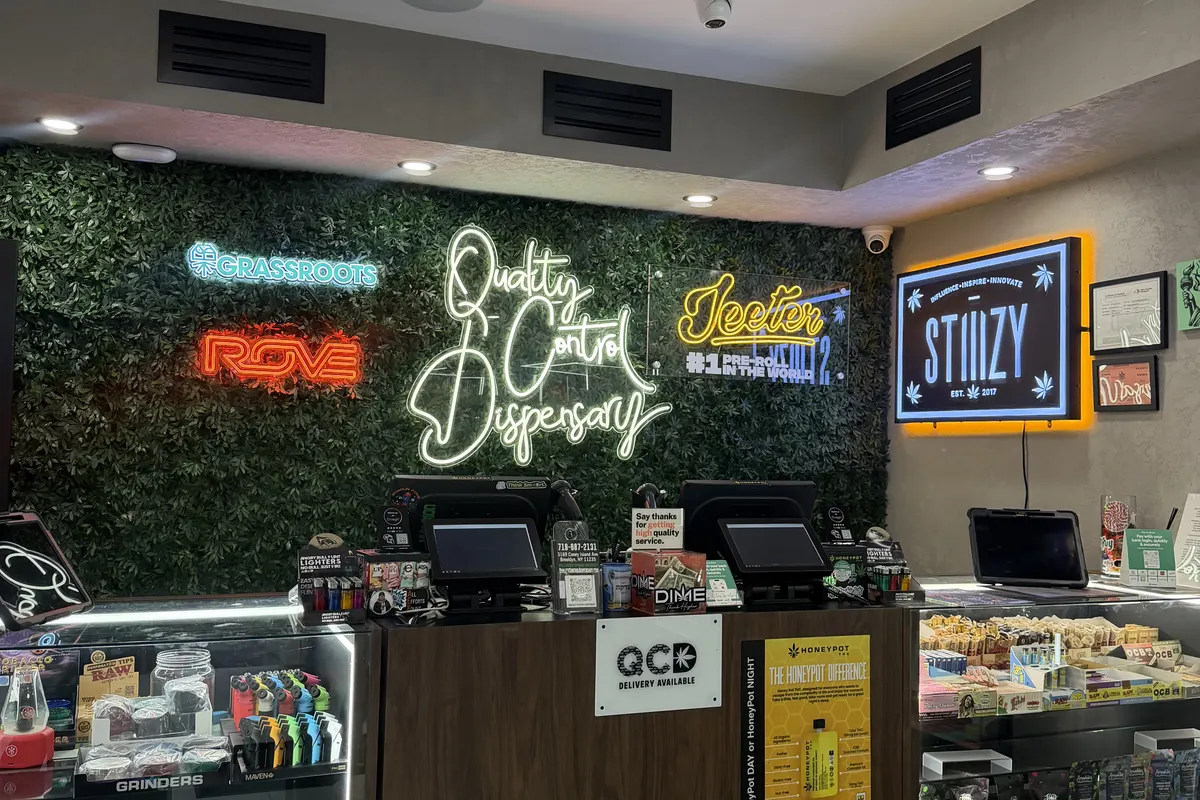
Lab-tested cannabis at QCD in Brooklyn and Staten Island
Knowing exactly what you are taking is the first step in keeping track of it. Every product at Quality Control Dispensary is lab-tested and labeled with its THC and CBD content, and budtenders can help you find lower-THC or CBD-forward options, single pre-rolls and low-dose edibles. Browse Brooklyn flower, Staten Island flower, Brooklyn edibles or Staten Island edibles.
Our Brooklyn store is at 3169 Coney Island Ave, Brooklyn, NY 11235, open Monday to Wednesday 8am to 11pm, Thursday and Friday 8am to midnight, Saturday 9am to midnight and Sunday 9am to 11pm. Our Staten Island store is at 1172 Victory Blvd #4, Staten Island, NY 10301, open Monday to Thursday 9am to 10pm, Friday and Saturday 9am to 11pm and Sunday 10am to 10pm. Walk in, order ahead for pickup, or get same-day delivery in Brooklyn and Staten Island. You must be 21 or older with a valid government-issued photo ID.
Sources
- Moeller KE, Kissack JC, Atayee RS, Lee KC. Clinical interpretation of urine drug tests: what clinicians need to know about urine drug screens. Mayo Clinic Proceedings, 2017.
- Lee D, Huestis MA. Current knowledge on cannabinoids in oral fluid. Drug Testing and Analysis, 2014.
- Centers for Disease Control and Prevention. Cannabis health effects and Cannabis and driving.
- National Institute on Drug Abuse. Cannabis (marijuana).
- New York State Office of Cannabis Management. Adult-use cannabis.